Number Tools



Tools for Working with Numbers
This collection covers a wide range of number-related tasks — from everyday calculations like percentages and grade curves to technical utilities like base conversion and random number generation.
Base Conversion
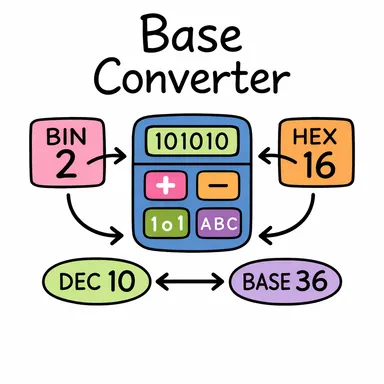
Numbers can be expressed in different bases (radixes). Decimal (base 10) is what we use every day. Binary (base 2) is fundamental to computing. Hexadecimal (base 16) is used in colour codes, memory addresses, and encoding. Octal (base 8) appears in Unix file permissions.
The base converter tool converts between any of these common bases instantly. The base conversion worksheets generate printable practice problems for students learning number systems.
Random Number Generation
The random number generator produces cryptographically random numbers in any range using the browser's
crypto.getRandomValues() API. This is the same source of randomness used in security-sensitive
applications — numbers generated this way are unpredictable and not reproducible from any pattern.
Random numbers are useful for games, simulations, sampling, picking lottery numbers, generating test data, and any situation where you need an unbiased selection.
Percentage Calculator
The percentage calculator handles the three most common percentage problems: finding a percentage of a number (what is 15% of 80?), finding what percentage one number is of another (20 is what % of 80?), and finding the original number from a percentage result (20 is 15% of what?).
Number to Words
The number-to-words tool converts numeric values into their written English form — useful for writing cheques, legal documents, or any context where numbers must be spelled out. It handles integers into the billions and supports ordinal forms (first, second, third).
Grade Calculators
The square root grade curve and linear grade curve calculators help teachers adjust raw test scores to target a desired class average or distribute grades along a curve. The grading calculator converts raw scores to letter grades based on configurable cutoffs.
Fraction Calculators
A dedicated set of fraction tools handles the most common fraction operations with full step-by-step solutions.
The Fraction Calculator adds, subtracts,
multiplies, and divides any two fractions or mixed numbers (enter 1 2/3 instead of juggling separate
fields). Supporting tools convert between
fractions and decimals,
decimals back to fractions, and
reduce any fraction to its lowest terms
using the Euclidean algorithm.
Frequently Asked Questions
- What is hexadecimal and why is it used?
- Hexadecimal (base 16) uses digits 0–9 and letters A–F to represent values 0–15. Each hex digit represents exactly 4 binary bits (a nibble), making hex a compact way to write binary data. Two hex digits represent one byte. It is used for colour codes (#FF5733), memory addresses, and any context where binary data needs to be human-readable.
- How does the random number generator work?
- The tool uses
crypto.getRandomValues(), which draws from the operating system's entropy pool — a hardware-seeded source of randomness. This is considered cryptographically secure, meaning the output cannot be predicted or reproduced from prior outputs. This is stronger than theMath.random()function used in most browser JavaScript, which uses a pseudo-random algorithm. - What is the difference between rounding and truncating?
- Rounding adjusts a number to the nearest value at the desired precision — 3.6 rounds to 4. Truncating simply drops the excess digits — 3.6 truncates to 3. For most everyday purposes, rounding is correct. Truncating (also called flooring for positive numbers) is used in programming when you specifically need to round toward zero.