Fraction Calculators
How Fractions Work — A Complete Guide
A fraction represents a part of a whole. Every fraction has two parts separated by a horizontal bar called the vinculum:
$$\dfrac{\text{numerator}}{\text{denominator}}$$The numerator (top number) tells you how many parts you have. The denominator (bottom number) tells you how many equal parts the whole is divided into.
For example, \(\dfrac{3}{4}\) means the whole is divided into 4 equal parts, and you have 3 of them.
Types of Fractions
Proper Fractions
A proper fraction has a numerator smaller than its denominator — its value is always between 0 and 1.
$$\dfrac{1}{2}, \quad \dfrac{3}{5}, \quad \dfrac{7}{10}$$Improper Fractions
An improper fraction has a numerator greater than or equal to its denominator — its value is 1 or greater.
$$\dfrac{5}{3}, \quad \dfrac{8}{4}, \quad \dfrac{11}{7}$$Mixed Numbers
A mixed number combines a whole number with a proper fraction. Every improper fraction has an equivalent mixed number.
$$2\dfrac{1}{3}, \quad 1\dfrac{3}{4}, \quad 5\dfrac{2}{7}$$To convert an improper fraction to a mixed number, divide the numerator by the denominator. The quotient becomes the whole number and the remainder becomes the new numerator:
$$\dfrac{11}{4} = 2\dfrac{3}{4} \quad \text{because } 11 \div 4 = 2 \text{ remainder } 3$$To go the other direction — mixed number to improper fraction — multiply the whole number by the denominator and add the numerator:
$$2\dfrac{3}{4} = \dfrac{(2 \times 4) + 3}{4} = \dfrac{11}{4}$$Equivalent Fractions and Simplifying
Two fractions are equivalent if they represent the same value. You can always multiply or divide both the numerator and denominator by the same number without changing the fraction's value:
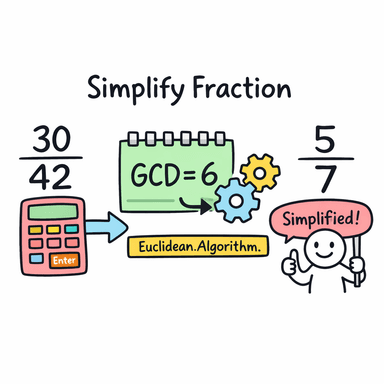
$$\dfrac{1}{2} = \dfrac{2}{4} = \dfrac{3}{6} = \dfrac{50}{100}$$A fraction is in its simplest form (also called lowest terms) when the numerator and denominator share no common factor other than 1. To simplify, divide both parts by their Greatest Common Divisor (GCD):
$$\dfrac{12}{18} \xrightarrow{\div 6} \dfrac{2}{3}$$The GCD of 12 and 18 is 6, so dividing both by 6 gives the fully simplified result \(\dfrac{2}{3}\).
Adding and Subtracting Fractions
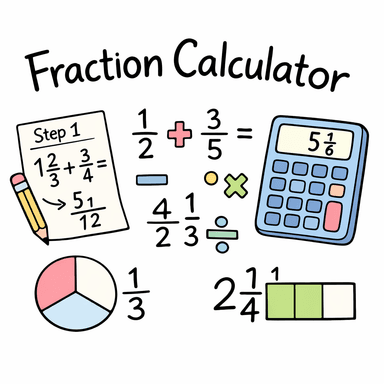
To add or subtract fractions, they must share the same denominator — called a common denominator. The best choice is the Least Common Denominator (LCD), which is the smallest number that both denominators divide into evenly.
Same Denominator
When denominators are already equal, simply add or subtract the numerators:
$$\dfrac{1}{5} + \dfrac{2}{5} = \dfrac{1+2}{5} = \dfrac{3}{5}$$Different Denominators
When denominators differ, find the LCD, convert each fraction, then add or subtract:
$$\dfrac{1}{3} + \dfrac{1}{4}$$The LCD of 3 and 4 is 12. Convert each fraction:
$$\dfrac{1}{3} = \dfrac{4}{12}, \quad \dfrac{1}{4} = \dfrac{3}{12}$$ $$\dfrac{4}{12} + \dfrac{3}{12} = \dfrac{7}{12}$$Multiplying Fractions
Multiplication is straightforward — no common denominator needed. Multiply the numerators together and multiply the denominators together, then simplify:
$$\dfrac{2}{3} \times \dfrac{3}{4} = \dfrac{2 \times 3}{3 \times 4} = \dfrac{6}{12} = \dfrac{1}{2}$$Tip: You can simplify before multiplying by canceling common factors diagonally — this keeps the numbers smaller and avoids simplifying a large result at the end.
Dividing Fractions
To divide by a fraction, multiply by its reciprocal (flip the second fraction upside down and change ÷ to ×). The phrase "Keep, Change, Flip" is a common memory aid:
- Keep the first fraction as-is
- Change the division sign to multiplication
- Flip the second fraction (swap numerator and denominator)
Converting Between Fractions and Decimals
Fraction to Decimal
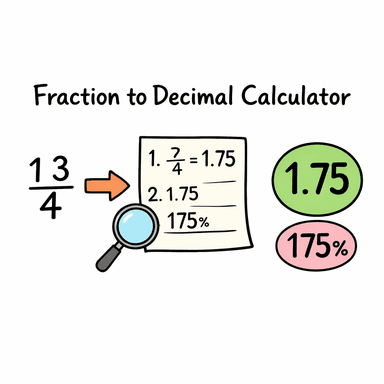
Divide the numerator by the denominator:
$$\dfrac{3}{4} = 3 \div 4 = 0.75$$Some fractions produce terminating decimals (they end), while others produce repeating decimals (a pattern of digits repeats forever). A fraction terminates in decimal form when the denominator's only prime factors are 2 and 5.
Decimal to Fraction
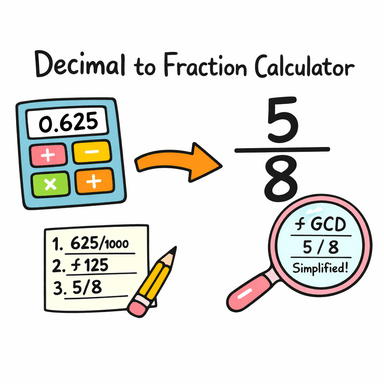
Count the decimal places and use that count as your power of 10 for the denominator, then simplify:
$$0.625 = \dfrac{625}{1000} = \dfrac{5}{8}$$Frequently Asked Questions
- What is the difference between a fraction and a ratio?
- A fraction represents a part of a whole (3 out of 4 equal pieces), while a ratio compares two quantities (3 to 4, which might mean 3 cups of flour for every 4 of water). They look identical but have different meanings depending on context.
- Why do you need a common denominator to add fractions?
- You can only add like units. Adding \(\frac{1}{3} + \frac{1}{4}\) without a common denominator would be like adding 1 foot + 1 yard and calling the answer "2." You first need to convert both to the same unit.
- Does it matter which common denominator I use?
- No — any common denominator will give the correct answer. Using the LCD just keeps the numbers smaller and means you'll need to simplify less at the end.
- Can fractions have negative numerators or denominators?
- Yes. A negative fraction can be written with the minus sign in the numerator, the denominator, or in front of the fraction — all three are equivalent: \(-\frac{3}{4} = \frac{-3}{4} = \frac{3}{-4}\). By convention the denominator is kept positive.
- What does it mean when a fraction is undefined?
- Any fraction with a denominator of zero is undefined. Division by zero has no meaningful mathematical value.